Good morning contemporary art and fashion lovers!
Check out the interview of my dear dear friend Victoria. She is an emerging actress, her career is exploding and her fashion tips are super useful.
Victoria Monfort is a French actress and blogger—with a killer sense of style. We sat down together to chat about her fashion and beauty tips, her travel experiences, and her exciting film career.
To learn more about her fashion and beauty tips:
http://hauteliving.com/2014/10/actress-victoria-monfort-shares-fashion-tips-tricks/528264/
Showing posts with label Interviews. Show all posts
Showing posts with label Interviews. Show all posts


10.19.2014
Fashion Designer Georgine Ratelband Dishes About the New Trends of the Season
Good evening contemporary art and fashion lovers!
When I met Georgine a few years ago, I fell for her design at the first sight.
She is a wonderful woman, very talented. Her clothes are chic, elegant, timeless and I am blessed being a part of in her inner circle.
Dutch born Georgine Ratelband graduated from Milan’s Istituto Europeo di Design in 2011 and created her eponym brand Georgine three years ago. Her Spring 2015 collection, which is inspired by the ’70s, received much acclaim during New York Fashion Week.
Check the whole interview we did for Haute Living:
http://hauteliving.com/2014/10/georgine-ratelband-fashion-designer-trends/527042/
When I met Georgine a few years ago, I fell for her design at the first sight.
She is a wonderful woman, very talented. Her clothes are chic, elegant, timeless and I am blessed being a part of in her inner circle.
Dutch born Georgine Ratelband graduated from Milan’s Istituto Europeo di Design in 2011 and created her eponym brand Georgine three years ago. Her Spring 2015 collection, which is inspired by the ’70s, received much acclaim during New York Fashion Week.
Check the whole interview we did for Haute Living:
http://hauteliving.com/2014/10/georgine-ratelband-fashion-designer-trends/527042/
‘Extra Virgin’ Star Gabriele Corcos Dishes About Food & Romance
Good evening contemporary art lovers!
Gabriele Corcos is not only a great cook, but also a great writer. The Florence born chef currently stars with his wife,Debi Mazar, in “Extra Virgin” on Cooking Channel. Throughout the show, the duo has given viewers a ringside seat into their inner circle—from running a farm in Tuscany to hosting dinner parties at their Brooklyn home.
I got the chance to meet him and Debi last Spring through of good friend of us and I asked him about doing this interview. We chatted about his unique cooking style, his must-have kitchen gadgets, and his ultimate dinner party guest list.
Gabriele, Debi, I thank you both so much for having did it and I looking forward to go to one of your dinners :)
Read More:
http://hauteliving.com/2014/09/extra-virgin-star-gabriele-corcos-dishes-food-romance/523522/
Gabriele Corcos is not only a great cook, but also a great writer. The Florence born chef currently stars with his wife,Debi Mazar, in “Extra Virgin” on Cooking Channel. Throughout the show, the duo has given viewers a ringside seat into their inner circle—from running a farm in Tuscany to hosting dinner parties at their Brooklyn home.
I got the chance to meet him and Debi last Spring through of good friend of us and I asked him about doing this interview. We chatted about his unique cooking style, his must-have kitchen gadgets, and his ultimate dinner party guest list.
Gabriele, Debi, I thank you both so much for having did it and I looking forward to go to one of your dinners :)
Read More:
http://hauteliving.com/2014/09/extra-virgin-star-gabriele-corcos-dishes-food-romance/523522/
3.10.2014
Fashion Photographer Pauline Darley Shares Her Definition of Beauty
Good morning contemporary art lovers!
I got the chance to meet French fashion photographer Pauline Darley a few weeks ago and to discover her work. After studying communications and completing several internships in the world of art and image, Darley progressively became a professional photographer creating ads for fashion magazines and portraits of celebrities. She has lived and worked in Paris since 2010.
What is your story? I started taking pictures when I was 17 years old simply because I was passionate about it. As far as I can remember, I never really wanted to become a professional photographer. When I moved to Paris (I am originally from Bourgogne), I took more and more pictures, shooting friends and friends of friends. Then I was asked about my rate and I got a job for a French magazine. In 2010, I decided to take up as a professional freelance photographer.
What camera do you use?
A Sony alpha 99 with a 24-70mm, a 50mm and a 85mm.READ MORE http://hauteliving.com/2014/03/fashion-photographer-pauline-darley-shares-definition-beauty/457861/
3.05.2014
Paula Crown Shares Her Journey from Wall Street to the Art World
Good morning contemporary art lovers!
I am pleased to introduce to you through this interview a new artist I just met: Paula Crown.
Paula Crown became a successful artist very recently. She served as Vice President of real estate finance at Salomon Brothers in New York and worked for a family-owned investment firm in Chicago. In 2012, she opted for a new artistic career and received her MFA in painting and drawing from the School of the Art Institute of Chicago. Crown was previously appointed to President Obama’s Committee on the Arts and the Humanities and also served a member of the board of trustees of the Museum of Modern Art in New York. She currently heads the museum’s education committee.
What made you decide to become an artist?
I am not sure one ever has a choice to become an artist. I asked my parents what I did before I was aware that anyone was looking…and I was always making and creating. They brought me to an adult studio at the age of 8 or 9 where I learned to paint with oils. Although my journey was indirect over the decades, it became clear to me that art was something I had to pursue full time in the last 10-15 years. I organized my life in a way to orchestrate that shift. As my four children grew older, I assembled a portfolio, took art classes at the School of the Art Institute and Anderson Ranch in Colorado with established artists and applied to art school. I reduced my for-profit work and community volunteer activities unless they had a direct relationship to my art (for example MoMA and the Presidential Committee for Arts and Humanities).
What is your background?
I received a BA degree from Duke magna cum laude in management science where I did a concentration in Italian renaissance art with the Titian scholar Rona Goffen. In 2012, I received my MFA from the School of the Art Institute of Chicago in painting and drawing.
The road became clearer as to how I was going to find my way to a full time practice. I was accepted into the MFA program at SAIC in painting and drawing and graduated in 2012 and opened a studio the following year. Fortunately, my work has had a positive reception and I have been able to show my work at the Aspen Institute, Chicago Expo, and currently at the Dallas Contemporary Museum. More will be announced for 2014 and 2015.
What is your favorite medium and why? I have a mind that is associative… I rarely see an idea in one medium or another. I think of myself as a trans-media artist for that reason. Often ideas can start with a pencil sketch that can translate into a 3D sculpture via scanning, and manipulation of that image in multiple planes. I might then animate the sketch and add audio or invert the coloration. I definitely feel more comfortable with tools of the trade that give me the satisfaction of direct mark making (i.e. brushes, markers, pencils) but I also love the image mediating power of Photoshop, processing and high resolution scanning. I paint primarily with acrylics due to allergies now.
READ FULL INTERVIEW:
6.02.2013
One-on-One with Tom Everhart
Good afternoon contemporary art lovers!
I recently had the honor of meeting Tom Everhart at an opening of his new exhibition organized by the AFA Gallery. Tom is a really nice and interesting artist who’s willing to talk about his art, making himself easy to reach. It was a real pleasure for me to learn more about his art, about him and the way he works. In 1980, Tom was introduced to cartoonist Charles M. Schulz, the man behind the beloved Peanuts comic. Schulz taught Tom his signature style, and made him the only fine artist authorized to use his characters. Since then, Tom’s Peanuts-themed paintings have become as iconic as the comic. “I never made it past that first blown up drawing of his strip. I sat in front of it for hours. I don’t even remember leaving it,” Everhart said of his inspiration. Here is my one-on-one with this incredible artist:
I recently had the honor of meeting Tom Everhart at an opening of his new exhibition organized by the AFA Gallery. Tom is a really nice and interesting artist who’s willing to talk about his art, making himself easy to reach. It was a real pleasure for me to learn more about his art, about him and the way he works. In 1980, Tom was introduced to cartoonist Charles M. Schulz, the man behind the beloved Peanuts comic. Schulz taught Tom his signature style, and made him the only fine artist authorized to use his characters. Since then, Tom’s Peanuts-themed paintings have become as iconic as the comic. “I never made it past that first blown up drawing of his strip. I sat in front of it for hours. I don’t even remember leaving it,” Everhart said of his inspiration. Here is my one-on-one with this incredible artist:
How did you come to becoming focused on the Peanuts?
It was after a long relationship with Mr. Schulz where he shared his teachings of his strategies of process and picture making.
As an artist known for works featuring characters from Schulz’s comic strips Peanuts, would you consider yourself more like a painter or like a cartoonist?
I have absolutely no background in cartooning, so the only thing I consider myself is a painter.
How would you position yourself compared to artists such like Roy Lichtenstein, whose paintings feature comic-style speech bubbles, or the Japanese artists who draw inspiration from Manga comics?
Well the only thing I have in common with Lichtenstein is that a lot of our imagery is based on cartoon subject matter but his painting were predominantly concerned with popular culture and graphics that accompanied that period of time where as my work is about events in my life.
4.23.2013
One-on-one with Fashion photographer Thorsten Roth
Good afternoon contemporary art lovers!
Born and raised in Germany, photograph Thorsten Roth moved in the USA in 2002. He now lives and works in NYC. He studied visual communication/photo-film-design and at the same time began to work in advertising and photojournalism. Right after his studies at the Fachhochschule Bielefeld (Germany) he started working for Conde Nast in Paris as a free-lance photo assistant. Roth's photography was published in Tatler Magazine, Marie-Claire, Cosmopolitan, MR Magazine, El Pais Semanal, Libération, Figaro, Jazz Magazine, URB Magazine, Dime Magazine, and MAR Magazine among others...
All images © 2013 All rights reserved by Thorsten Roth. For more information on Thorsten Roth, please visit his website.
Born and raised in Germany, photograph Thorsten Roth moved in the USA in 2002. He now lives and works in NYC. He studied visual communication/photo-film-design and at the same time began to work in advertising and photojournalism. Right after his studies at the Fachhochschule Bielefeld (Germany) he started working for Conde Nast in Paris as a free-lance photo assistant. Roth's photography was published in Tatler Magazine, Marie-Claire, Cosmopolitan, MR Magazine, El Pais Semanal, Libération, Figaro, Jazz Magazine, URB Magazine, Dime Magazine, and MAR Magazine among others...
First time you realized you were born to be a photographer?
“I was around fifteen and the best student in a photography school class. I had started taken pictures and filming Super 8 three years prior but at this point I became very conscious about my fascination even obsession with photography. I was driving around on my little motorcycle to find interesting things to shoot: landscapes, people, buildings I also read anything about photography I could get into my hands.
At one point I saw a documentary about Oliviero Toscani on T.V. creativedirecting and shooting Benetton and it made 'Click' in me and my guts told me: "You have something going on just like this guy."
Long story short all of this lead for pursuing studies in Photo/Film at one of the best German DesignColleges and moving to Paris. It turned out that ten years after seeing the documentary I was standing as an assistant with Oliviero on a Benetton PhotoSet.
Funny how life turns out when you want something real bad! :)”
Who have inspired you to become an artist?
“I owe that certainly to my teachers and my education at the beginning my family was not really crazy about my choice. It was through the exposure to art in museums, exhibitions and watching documentaries and movies on T.V. that provided inspiration.
Artistically I grew up with Bauhaus, New Objectivity and German Expressionism I loved particularly the painters Max Beckmann, George Grosz, Otto Dix on the film side certainly Fritz Lange later on Rainer Werner Fassbinder, Volker Schloendorff and Wim Wenders.
In college I really fell in love with French Impressionism which lead to the decision to move to Paris after college and to the result that I've lived there for twelve years.”
“I was around fifteen and the best student in a photography school class. I had started taken pictures and filming Super 8 three years prior but at this point I became very conscious about my fascination even obsession with photography. I was driving around on my little motorcycle to find interesting things to shoot: landscapes, people, buildings I also read anything about photography I could get into my hands.
At one point I saw a documentary about Oliviero Toscani on T.V. creativedirecting and shooting Benetton and it made 'Click' in me and my guts told me: "You have something going on just like this guy."
Long story short all of this lead for pursuing studies in Photo/Film at one of the best German DesignColleges and moving to Paris. It turned out that ten years after seeing the documentary I was standing as an assistant with Oliviero on a Benetton PhotoSet.
Funny how life turns out when you want something real bad! :)”
Who have inspired you to become an artist?
“I owe that certainly to my teachers and my education at the beginning my family was not really crazy about my choice. It was through the exposure to art in museums, exhibitions and watching documentaries and movies on T.V. that provided inspiration.
Artistically I grew up with Bauhaus, New Objectivity and German Expressionism I loved particularly the painters Max Beckmann, George Grosz, Otto Dix on the film side certainly Fritz Lange later on Rainer Werner Fassbinder, Volker Schloendorff and Wim Wenders.
In college I really fell in love with French Impressionism which lead to the decision to move to Paris after college and to the result that I've lived there for twelve years.”
READ MORE: http://www.hauteliving.com/2013/04/one%C2%AD-on-one-with-photographer-thorsten-roth/353263/
Thank you Thorsten! Well I guess there is only to add to this interview: Break a leg...
Thank you Thorsten! Well I guess there is only to add to this interview: Break a leg...
All images © 2013 All rights reserved by Thorsten Roth. For more information on Thorsten Roth, please visit his website.
4.12.2013
Exclusive Interview with travel writer Francisca Matteoli
Good evening contemporary art lovers!
Chilean, with a Scottish mother, Francisca Mattéoli spent her childhood in Latin America. After living in Brazil, she now resides in Paris and is the author of numerous travel books published in more than ten countries and translated in several languages. As a travel writer, she has also been published in, among others, National Geographic France and Conde Nast Traveller.
Absolutely. They have been an inspiration for me. They show a world that does not exist anymore, the golden age of travels, and also, each page tells a story – about my roots, my family history, their travels, around the globe and, in the chilean countryside. They sumerize everything I am.
Chilean, with a Scottish mother, Francisca Mattéoli spent her childhood in Latin America. After living in Brazil, she now resides in Paris and is the author of numerous travel books published in more than ten countries and translated in several languages. As a travel writer, she has also been published in, among others, National Geographic France and Conde Nast Traveller.
Born and raised in South America, you have Scottish roots and you live in Paris. Do you feel having the urge to travel since you were a little girl?
Yes. When I lived in Chile, I was travelling in imagination before I started travelling myself, thinking about the places where my parents and grandparents have been and imagining their adventures. I was also travelling at home in a way , with my parents and their 2 nationalities, so different. It was a normal thing for me and I suppose that is why I became a travel writer. I felt always really myself between two worlds.Absolutely. They have been an inspiration for me. They show a world that does not exist anymore, the golden age of travels, and also, each page tells a story – about my roots, my family history, their travels, around the globe and, in the chilean countryside. They sumerize everything I am.
Please tell us about the photo albums your mother made. Could we say that you traveled through them?
Absolutely. They have been an inspiration for me. They show a world that does not exist anymore, the golden age of travels, and also, each page tells a story – about my roots, my family history, their travels, around the globe and, in the chilean countryside. They sumerize everything I am.
READ MORE:
6.13.2012
Laurence Jenkell
Good evening contemporary art lovers!
Here is the latest interview I did with a French-born artist Laurence Jenkell. Well-known in France, her "candies-sculptures" can be seen everywhere in Paris in most of the famous places such as Matignon, Arc, Laduree..... Born in 1965, she used to work in hotel business before becoming an artist. She currently lives and works in South of France.
Here is the latest interview I did with a French-born artist Laurence Jenkell. Well-known in France, her "candies-sculptures" can be seen everywhere in Paris in most of the famous places such as Matignon, Arc, Laduree..... Born in 1965, she used to work in hotel business before becoming an artist. She currently lives and works in South of France.
Your influences range from Pollock to Arman and before being a sculptor you were a painter. What did you learned from those artists and how did they influence you?
I am self-taught and when I started to visit museums, I was literally impressed by the impressionists. I was impressed by the sheer joy of their paint, their innovations, the motion of the colors by small stroke. I used to love the Musee d’Orsay for its unequalled collection of paintings by Monet, Cezanne, Van Gogh, Renoir, Sisley, Degas… What I basically retained from those early experiences is that one must free oneself, go out to the cancans, invent one’s own color palette, in the same way as one invents ones own life and innovate without fear of what people might say. I was then and am still fascinated by Picasso whom people think they know because they have seen several of his works, only to discover new works and especially in these works, an intelligence which can only serve as reference.
Your work is henceforth recognized by your huge “sculptures-candy”. Why did you choose this emblem as a reference?
An artist must find his own language. Impose his/her style. As far as I am concerned, the subject of Candy imposed itself on me because, as a child, I was not allowed any sweets and I suffered not being able to eat candies like my friends did. A childhood frustration is today my revenge since Candy has now become my predilection which I continue ad infinitum. The first Candy works were composed on canvas with real candies which I heated in the kitchen oven, then I continue with abstracts compositions on canvas treated with resin or epoxy.
READ MORE:
http://www.hauteliving.com/2012/06/haute-art-exclusive-one-on-one-with-laurence-jenkell/
READ MORE:
http://www.hauteliving.com/2012/06/haute-art-exclusive-one-on-one-with-laurence-jenkell/
5.15.2012
INterview with Michaela Gleave
Good afternoon contemporary art lovers!
Michaela is a young Australian-born artist (1980) whose work questions the passage of time and the relationship to the nature...
1 – Dear Michaela, what made you decide to become an artist? Who are those who influenced you?
« The first job I remember wanting to have as a child was to draw pictures of animals, but growing up in remote and regional Australia being an artist wasn’t something I ever thought of as a possibility. I didn’t see any contemporary art until I was 18 and spent a gap year in Europe, and experiencing installation art for the first time was tremendously exciting. I remember a work at the Tate St Ives that included a sea of rotting carrots, and one in Paris which was a giant blanket cubby that had to crawled through on hands and knees. I was also lucky enough to stumble across the Venice Biennale when travelling through Italy and saw the work of Ann Veronica Janssens. She had filled the Belgian Pavilion with cloud, completely arresting the viewer’s experience of time and space. The use of the viewer as a physical agent in these and other works, and the dissolution of the traditional gap between audience and object dramatically changed my perception of what art was and the possibilities available to an artist. »
2 – Some of your works question the passage of time and our relationship with the nature. Environmental problems are important to you?
« I think time is the ultimate sculptural material, virtually impossible to manipulate in any real sense, so the suggestion I saw in Jansenns’ work that this might be possible through art was an important formative moment for me. Time is a crucial element in my works and generally I have very little desire to make things which will last, due mostly I think to the futility of attempting to do so in the face of infinite time and space. Creating things which unfold in real time, unmediated experiences of an actual event occurring before the viewer, has always been a key focus of my practice. I aim through my work to connect the viewer to things that are larger than themselves and I’m not interested particularly in making work about people, rather in exploring that which exists just beyond the realm of human perception as a means of questioning how it is that we see, interpret and engage with the world around us. On a personal level I have a deep love for the natural environment – the beauty inherent in nature far outstrips anything that can be created – but I see the role of the artist as one of asking questions, not dictating answers.....
READ MORE:
http://www.hauteliving.com/2012/05/haute-art-exclusive-interview-with-australian-artist-michaela-gleave/
Michaela is a young Australian-born artist (1980) whose work questions the passage of time and the relationship to the nature...
1 – Dear Michaela, what made you decide to become an artist? Who are those who influenced you?
« The first job I remember wanting to have as a child was to draw pictures of animals, but growing up in remote and regional Australia being an artist wasn’t something I ever thought of as a possibility. I didn’t see any contemporary art until I was 18 and spent a gap year in Europe, and experiencing installation art for the first time was tremendously exciting. I remember a work at the Tate St Ives that included a sea of rotting carrots, and one in Paris which was a giant blanket cubby that had to crawled through on hands and knees. I was also lucky enough to stumble across the Venice Biennale when travelling through Italy and saw the work of Ann Veronica Janssens. She had filled the Belgian Pavilion with cloud, completely arresting the viewer’s experience of time and space. The use of the viewer as a physical agent in these and other works, and the dissolution of the traditional gap between audience and object dramatically changed my perception of what art was and the possibilities available to an artist. »
2 – Some of your works question the passage of time and our relationship with the nature. Environmental problems are important to you?
« I think time is the ultimate sculptural material, virtually impossible to manipulate in any real sense, so the suggestion I saw in Jansenns’ work that this might be possible through art was an important formative moment for me. Time is a crucial element in my works and generally I have very little desire to make things which will last, due mostly I think to the futility of attempting to do so in the face of infinite time and space. Creating things which unfold in real time, unmediated experiences of an actual event occurring before the viewer, has always been a key focus of my practice. I aim through my work to connect the viewer to things that are larger than themselves and I’m not interested particularly in making work about people, rather in exploring that which exists just beyond the realm of human perception as a means of questioning how it is that we see, interpret and engage with the world around us. On a personal level I have a deep love for the natural environment – the beauty inherent in nature far outstrips anything that can be created – but I see the role of the artist as one of asking questions, not dictating answers.....
READ MORE:
http://www.hauteliving.com/2012/05/haute-art-exclusive-interview-with-australian-artist-michaela-gleave/
4.20.2012
Domingo Zapata!!! Artist to watch...
Good evening contemporary art lovers!
A
Domingo Zapata is a Spanish-born artist (1974) who maintains studios at the historic Bowery Hotel in New York City, the legendary Chateau Marmont in Hollywood. He’s well-known for his works which explore themes of sexuality, opulence, and vitality. Texts and visual cues can also be included in his works that attracte many of the world’s most prestigious collectors. He’s an “artist to watch” and he will announce the details of his first museum show in the coming months.

1- Domingo, have you always wanted to become an artist? Who are the artists who have influenced in your youth or the works of art that have thrilled you?
“I have always been a painter, an artist throughout all of my life. I choose to do this fulltime now and all the experiences I had in the past have contributed to what I create today. Paul Cezanne to me is the master of Modern art! From him Picasso developed and open all the new doors to my inspiration… I try to learn about Cezanne everyday looking for answers and bring it contemporary using today’s techniques.”
2 - You explore themes such as sexuality, opulence, vitality through colorful, bright and joyful paintings. What message would you like to pass on through your art?
“I am using a more urban approach with mixed-media, influenced by the streets near where I stay and the time I have spent in New York. I love using vintage posters and imagine what would happen to them if they were posted in the street. What would street artists do to them? How the weather might affect them.
Polo horses remind me of my youth and love for horses.
Bullfighting is a passion that I even practice when I go back to Spain at my friend El Litri’s estate (he is the best bullfighter in the world and one of the nicest people I know). He is my inspiration for this motif....
READ MORE:
http://www.hauteliving.com/2012/04/haute-art-domingo-zapata-or-the-one-who-runs-the-art-world/
www.dzapata.com/
Domingo Zapata is a Spanish-born artist (1974) who maintains studios at the historic Bowery Hotel in New York City, the legendary Chateau Marmont in Hollywood. He’s well-known for his works which explore themes of sexuality, opulence, and vitality. Texts and visual cues can also be included in his works that attracte many of the world’s most prestigious collectors. He’s an “artist to watch” and he will announce the details of his first museum show in the coming months.

1- Domingo, have you always wanted to become an artist? Who are the artists who have influenced in your youth or the works of art that have thrilled you?
“I have always been a painter, an artist throughout all of my life. I choose to do this fulltime now and all the experiences I had in the past have contributed to what I create today. Paul Cezanne to me is the master of Modern art! From him Picasso developed and open all the new doors to my inspiration… I try to learn about Cezanne everyday looking for answers and bring it contemporary using today’s techniques.”
2 - You explore themes such as sexuality, opulence, vitality through colorful, bright and joyful paintings. What message would you like to pass on through your art?
“I am using a more urban approach with mixed-media, influenced by the streets near where I stay and the time I have spent in New York. I love using vintage posters and imagine what would happen to them if they were posted in the street. What would street artists do to them? How the weather might affect them.
Polo horses remind me of my youth and love for horses.
Bullfighting is a passion that I even practice when I go back to Spain at my friend El Litri’s estate (he is the best bullfighter in the world and one of the nicest people I know). He is my inspiration for this motif....
READ MORE:
http://www.hauteliving.com/2012/04/haute-art-domingo-zapata-or-the-one-who-runs-the-art-world/
www.dzapata.com/
4.08.2012
Rob Wynne !!!
Good morning contemporary art lovers!
I'm very pleased to present an interview of Rob Wynne, a good friend of mine and an amazing artist....
www.robwynne.net/

I'm very pleased to present an interview of Rob Wynne, a good friend of mine and an amazing artist....
www.robwynne.net/

1 - Dear Rob, could you please introduce yourself and
tell us what is your background? How did you become an artist?
As a young child I had dyslexia - which made it extremely
difficult to READ. Oddly, I could read music very easily……but knew that I would
not be able to excel as I wanted in that field. I could draw and when it came
time to go to college, I went to Art School (Pratt Institute, in Brooklyn NY)
After a long period of making abstract paintings - I took a long pause and
redirected my work to TEXT, challenging my childhood issues, and began working
with NARRATIVE . The ability to change my mind and point of view was for me a
life changing experience.
2 - Words mean a lot to you. They are the main subject
of your art, why?
See ABOVE!!!
3 - Why did you choose to use glass a main material?
I am NOT a classically trained "glass artist"
about 15 years ago, I was making an exhibition for Holly Solomon, my dealer at
that time. It was called "SLEEPWALKING" and was loosely based on an
early 19th century Opera, "La sonnambula" I had wallpapered the
entire gallery and made large scale silkscreen paintings on fabric….I wanted to
have a pair of GLASS FEET - to convey a sense of being and not being present.
Not knowing anything about glass working , I was put in touch with a trained
technician…and was able to make the FEET. After that I just started hanging
around the glass studio and watching and picking up bits of technique. I was
then invited to be a "visiting artist" at Pilchuck in Seattle, which is
the mecca of the studio glass art movement in the USA. I started to just fool
around with GLASS and tried to use it in unorthodox ways. That said, working
with glass is collaborative, insofar as you cannot do it alone. I have worked
with a crew of assistants since then…always trying to break rules and embrace
the imperfection in glass making, which runs contrary to the typical techniques
used.
4 - How do you position yourself compared to
Jean-Michel Othoniel and Angelo Filomeno who also use glass in their works?
Vis a vis Othoniel and Filomeno, whom I admire very
much…..I think the commonality that we share is that we are NOT "glass
artist's" in the traditional sense. Interestingly the range of
contemporary artists using glass as a material in their work is fairly
substantial: ie: Kiki Smith, Beverly Sims, Robert Gober, Mary Carlson, Joan
Jonas (in performance), etc. - some Modern Masters like Duchamp( The Bride
Stripped Bare) and Pollack ( who mixed glass in his pigment) also used glass.
For me, glass is another material to experiment with, albeit, one that does
need a large amount of knowledge to handle.
5 - How do you place yourself in the contemporary art
market? Do you feel any affiliation to one movement or another?
I don't place myself in the Art Market…I just try to make
things that interest me.
6 - Could you please tell us about your collaboration
with Dior?
The Architect Peter Marino ( a collector of my work)
approached me through JGM.Galerie some years ago about doing a piece for the
flagship DIOR boutique in Paris. Peter is in charge of the design of DIOR world
wide. He has since then asked me for pieces for other DIOR venues. They
typically tell me the perimeters and then I give them drawings of various
ideas in my Poured Glass work. Et Voila!
Thanks a lot my dear Rob. It's always a pleasure
2.21.2012
Pepe Smit !!!!!
Good afternoon contemporary art lovers!
here is the an interview of a young an wonderful artist Pepe Smit... I let you discover her work...
http://www.pepesmit.com/recent_work_video_picnic.html
here is the an interview of a young an wonderful artist Pepe Smit... I let you discover her work...
http://www.pepesmit.com/recent_work_video_picnic.html
1- Dear Pepe, tell us about yourself, what is your background and who
inspired you when you were young?
I come from The Hague, my father was a filmmaker and my mother a set
dresser. I have always seen my mother make all kind of things. I think this has
helped me to believe you can make almost anything yourself. I always make my
own film and photo sets and I like to make things look good with very little
money and a lot of tricks...
2 - What is the impact of the Luncheon on the Grass made by Manet on you?
"Le Dejeuner sur l'herbe" by Edouard Manet made a real stir when
it was first exhibited at the "Salon des Refusés" in Paris in 1863.
The impertinence of the naked woman sitting between the two dressed men was of
a totally different order than the aesthetic nudes known in the arts at that
time. The woman stares provocatively at the viewer and in doing so she makes
the viewer into a voyeur and accomplice. In my video I reverse these
roles: the man is naked and the women are having a picnic. Just like the work
of Manet the video carries a provocative tone in which the viewer is challenged
to form an opinion. Making the spectator an accomplice is something I
that is very appealing to me and many times I have used this in my work.
3 - Why have you decided to make your own one?
The use of naked woman in art is something that interests me. Manet in a
way questioned this role. The most degraded naked woman are perhaps naked woman
used as furniture. In the seventies the artist Allen Jones made a coffee
table out of a female doll, but also the Milkbar in Stanley Kubrick's "A
Clockwork Orangeis full of women who serve as furniture. The masculine
furniture in the my work can be understood as a hitherto missing counterweight
in art history. I thought it would be a way humorous revenge these women.
4 - In yours, the man is naked and the girls are eating on his back like
a dinning table. Is it just like a joke or did you want to convey a deeper
message?
In the work we see two women and a naked man. The naked man is hardly a
character, he is degraded to a "prop": a side table that provides the
women with all kinds of decadent and luxury items. In spite of their unbridled
lust for extravagant luxury such as lots of champagne, chocolates, cakes and
fruit, they cannot suppress boredom. This is pure decadence but also something
that could have taken place anywhere, anytime: women who can afford to
look beautiful in expensive clothes, who can eat and drink whatever they want,
spending all day gossiping and laughing with a friend. They are trophy wives
who serve as a status symbol or, later in life, like the woman in this video,
have ones been trophy wives and are now obliged to forfill this role forever. A
state of being which inevitably leads to enormous boredom.
5 - What do you think of Feminist Art? do you feel any affiliation?
Growing up in the seventies I was raised between feminists. Being
independent was a must. But nowadays I notice that a lot of women (especially
the Nouveau Riche), to whom freedom and independence is totally normal,
independence and freedom do not mean much anymore. They throw it all overboard
to stay home and bake cookies with the kids in their expensive kitchen on their
Gucci boots. And I myself like to do things like that to. Sometimes. I like my
position to be on the sideline. I see what happens and I see the weirdness and
the humor of it but I could be doing the seem thing myself. So I try not to be
judgmental, I just want to reveal even to to fillet everyday things like
gender roles, power relationships and stereotypes. In a humorous way and with
sugar-sweet venom. I do feel affiliation with some feminist art. I like Dana
Wyse for instance, Cindy Sherman and also the Guerrilla
Girls girls. But in general I like art or I don’t, regardless if it was
made by a man or a woman. Because my name is also a man’s name people
often think that my work was made by a man. It can be quite a surprise when
they find out I’m a woman!
8.31.2010
Martin Denker, artist, between photograph and visual art
Good afternoon contemporary art lovers!
Martin's work is the reflection of his own world, the one where he brings us. When you have a look on his works for the first time, you cannot be focused only on one point. They don't really have any foreground or background and photographs are full of details and symbols whom have the same and equal value. You can stand right in front of the photographs for hours and try to discover and understand their significations. Each time another sense appears... He found his inspiration in our society (images of foreign cities, of people and situation, of data material from the Internet...) using all the details he can find. He picks them up, put them together and creates a new reality based on his own perception of the world. He transforms and merges two bodies, the symbioses of human and virtuality, animal or machine... A process that reminds us the countless visualized transformations in the films made by David Cronenberg. Apparently the world isn't big enough for him! He destroys images to finally recreate them. He fragments and restructures them as in a kaleidoscope.
Dear Martin, could you please introduce yourself? During your studies, have you been influenced by any artists as Thomas Ruff for example?
"My name is Martin Denker, I was born in Hamburg in 1976 and I'm a photographer and a painter. I studied literature and fine arts in Greifswald/Germany from 1996-2000, painting and photography in San Antonio/USA from 2000-2001 and photography in Dusseldorf/Germany, from 2001-2006. I have been influenced by several great teachers and artists and to mention each one would mean to go beyond the scope of this interview...
My earliest important influence as I see it today was perhaps my teacher Ronald C. Binks from Chicago, who was my professor in San Antonio. Ron taught me painting and large format photography and he was the one to actually tear down the barriers in my visual thinking, giving me a more transcending perception and a freedom of view. [...] he introduced me to White's works along with the works of his contemporaries Stieglitz, Steichen, Adams, Weston, Cunningham, etc... Ron is a god of Black and White photography, a wizard in composition, developing film and printing. To see him dodge and burn b/w prints like a painter in the lab was a great source of inspiration for me. [...]. And Ron is an exceptional paitner and draftsmen influenced mainly by Beckman and Bacon, which is maybe important towards understanding my own work in the force field between painting and photography. The same aesthetical set of rules applies for painting, photography and even performance, sculpture, acting, writing, etc..., that was my conclusive deduction from my studies with him.
Another influence in my US days was photographer Swain Edens. [...] he was one professional shooter introducing me to lighting, digital photography and postproduction. [...]. When it comes to accuracy, perfection and details it's definitly what I learned from Swain Edens in the professional environment of his studio.
During these days, I also studied Photoshop at the University and I got more and more into working on the screen instead of the easel. I traded in pigment for pixel, so to say. When I returned to Germany in 2001 I started my studies at the Art Academy in Dusseldorf and I decided to study with Thomas Ruff, who was another fundamental influence on me. Thomas had been using the computer to enhance and manipulate his photographs since the early 1990s and by the time I picked up my studies he had totally turned away from shooting with a camera. His works, especially the nudes and the substrates, have been a crucial influence in those days, for I perceived them as paintings produced with photographic means.
The concept of the substrates is the effect of visual bulk: due to having too much information available, the image becomes an appealing, colorful surface in the process of blending and the content is not accessible any more although it exists. A parallel to our world: a deluge of information leading to superficiality by losing precision. A process of entropia with information becoming a white noise. Thomas achieved that effect by layering images in the computer. Et voila... that is how I could describe my own work with few words. I'd say I started developing my visual language out of the words that the substrates had spoken.
[...] In 2002 I started working with Andrea Gursky, with whom I have the closest relationship and I have spent most time with. Maybe he is my most important influence, also because I travelled the world with him and at times we shared every hour of the day for weeks in a row during projects [Olympic games in Athens, countless Formula 1 around the globe, stock markets in the Middle East...]. He showed me a planet, so rich in detail, that an image seemed hardly enough to capture the observations we made. [...] He has taken photography to a peak, he has created a vocabulary of understanding global culture and he's showing that mass leads to abstraction, just like Thomas has done with the substrates. The difference is, that in Andreas works you can still see every detail. So I think I can be found somewhere between those two concepts. [...]'
You have established your career between photography and visual arts. Could you please explain us what it means with your own words? How would you define your work and your process?
"For an artist I think it's important to stay open-minded and curious and look at things as phenomena. Distinctions and notions can be dangerous, they might limit you with a process of categorizing the world and putting things into certain drawers... Creation is born out of exceeding the limits and questioning existence as we think we know it. It is walking new ways and leaving the roads where everybody else walks. That's why it doesn't matter too much to me if something is called photography or painting.
Photography is as vague as painting, especially today with a vast culture of image altering: it's all lies, but these lies can help you find a truth for yourself. Photography as painting are both individual versions of the world coined by the author and not a true reproduction of ideas. It's more about how we look at things and I think the reaction int he viewer is more important than the artist or the work.
Some people seem to have problems with my images, simply because they don't know what my works are - painting or photography? They are both and much more. I could say they are music without tones. It's dangerous when we need someone else's label to formulate our own opinion. But I guess that is a consumerists' attitude and in the explosion of notions we're facing today, people need more than ever a guide, a gatekeeper to tell them what they can't have. We can take this all the way down to Thomas Hobbes "Leviathan".
Basically my images are symphonic collages out of the visual debris of our exploding cultures: the permanent feeling of "too much" and the stress to miss something important that we all feel today, exemplified by countless stimuli - all this casted into a square trying to find harmony in chaos. They are about constant availability, ubiquity, restlessness in a saturated world that still wants to grow and stimulate and entertain and catch everyone's attention for the products that we don't need. It's being on the cell-phone on an airport in Asia, talking to someone you used to know thousands of kilometer away, while watching a commercial for a gated community in Dubai, it is the impenetrable universe of glamour, glitz and advertisement. They are about loss of physicality and content, the disability to make sense and effort to maintain sanity in a space that seems to be endless and doesn't prevail orientation.
Technically, I start my journey - and it's traveling! - with one of my own photographs as the framework. This image has a story, that i'm extending. I run search engines like google to find information and deviate in a stream of consciousness through the digital realms. It's a reduction to the maximum in a way. it's like writing a novel. I create a plot and I erase what doesn't belong to the storyline, I add and cut, I link and disconnect, I highlight and I camouflage. I put arbitrary words into the search engines and do an image search and I might end up with pig breeders in Arkansas, some teenager's online poetry or a manufacturer of lawnmowers in Russia.
For em this way of working is the logical consequence of creating images today. If the internet was an actual entity where you could walk around, these would be the photos I would bring home. Art is looking from a platform in the clouds at the world. I don't see why I should contribute another portrait, landscape or still-life to art history. I've seen more than everything, like everybody else. Almost more than everything..."
Your works, which look like a new type of kaleidoscope, bring us into a wonderful and unreal world where many details and symbols are represented. How do you decide to choose one particular detail instead of an other?
"Haha... I don't choose, I use all of them! What's interesting: Caleidoscope means "to see beautiful forms"; but seriously of course my works are a diary for me to a certain extend. Let me give you a recent example: in the course of the financial crisis I was doing research on the history of commerce and I found out how closely wars have often been connected with financial breakdowns, which is terrifying, and then I ran into the logos of the banks involved and partly find vulgar displays of power, like the Merryl Linch logo, which is a bull. Or Lehman itself used the phrase "Where Vision Gets built" - interesting! I start seeing "beautiful forms" and all of this takes me back to a culture of greed and facade that we live in. I also found old etchings from the US civil war in 1862, which was connected to a financial crisis... With these images cut/pasted I create my version of what was an ungraspable enigma to me before by creating my own mythology.
The choice of raw-material is a mix of aesthetic consideration and the necessity of its meaning towards the whole: in the transformation and dispensation of the original source material into the work, I apply the mechanisms, that the human brain uses to suppress and enhance detail in our memory to give us a limited universe of orientation. My actions can be seen as a parallel to the work that the hippocampus in the middle-brain is doing. It filters the flood of input in a loop and tries to create a system of useful logics towards our individual existences. Every human brain is an individual image."
Regarding the evolution of the art market and the place taken by the virtual galleries (sometimes owned by the artist himself), what is your definition of the contemporary artists and its role in the market? Do you think that an artist could be his own art dealer?
"It's not useful towards creative work when an artist is involved too much in market activities. Unfortunately this is often inevitable with the way the global market works, because you are selling your soul and you want to make sure, that it ends up in good hands and is mediated properly! And the dealers make money with your creativity, they're not the ones who suffer for creating beauty, they sell it. It's two totally different stories...
The market is a lot about vanity and surface and I'm happy that I don't have to do the job myself, it's a full-time job that suffocates my creative forces. I find it useful, not to be present in the commercial art world, if possible. In the Western cultures, art has been used and abused to display the power of authorities like the Church and royal courts ever since, and contrary to Asian cultures, it has given art the air of something holy which exists only for a precious few who can show it to the rest of the world. It's still the same: money is the Church today and an ideal gadget of differentiation from your neighbors is putting art into your place, that they can't own because you have it. This is why the whole art circus is needed: it's our Western notion of art. You need to hit people with a hammer and tell them what they need. You wouldn't buy a Bentley online either, would you? You want a glass of champagne in a leather couch and a good-looking sales-person when you spend the GPD or a small african country for a car or a sculpture by Jeff Koons.
The good news is that the market makes art possible in the first place and accessible to those who really love it and want to learn. An artist is a mediator, a seismograph, a chronicler. Artists are the ones who conserve their time in a vivid and profound way. When, let's say, you want to get a feeling of the days of evolving early modernism, you look at Picasso and listen to Stravinsky or read Proust. At some point you have left a statement to the world as an artist and nobody will care in which way a work got into which place. Concerning online galleries: I think art has to be seen in person in the right spaces. The mass of online offers might blur quality with quantity."
A lot of contemporary emerging artists are from Germany. Do you feel close to them and are you related to any particular movement?
"It's true, many artists come from Germany or move here. I think the working conditions are good in Germany and Germans are interested in culture. Benefits start with affordable studio space, awards, grants, etc... and end with the institutions and the number of collectors and museums The art scene is big, colorful, professional and various. I heard that for instance in Paris most artists just can't afford studio space anymore and so are threatened by extinction in Paris itself. If you look at it, there are not so many international artist from France around today, although it was the Mekka for art not too long ago.
I wouldn't say I consider myself part of a movement and then are there any these days? I mean, you have the Leipzig school of painting here with a certain style which could be called a movement, but I think the vast variety of styles in the contemporary art makes it hard to classify movements. I'm in touch with other artists and I look at shows, but I'm not part of a group.
Then I also think, that globalization has rather quickly changed the conditions in which we live and work in the art world today: it's not like a limited crowd is having their privy shows in town anymore. Damien Hirst said the other day, that the contemporary artist spends more time with a laptop in the frequent flyer's lounge than in front of an easel. Maybe the truth can be found in the middle."
Thank you so much Martin for this fantastic interview! I's a real pleasure to discuss with you and I'm glad to learn more about you and your work. And I'm sure I'm not the only one!
Martin's work is the reflection of his own world, the one where he brings us. When you have a look on his works for the first time, you cannot be focused only on one point. They don't really have any foreground or background and photographs are full of details and symbols whom have the same and equal value. You can stand right in front of the photographs for hours and try to discover and understand their significations. Each time another sense appears... He found his inspiration in our society (images of foreign cities, of people and situation, of data material from the Internet...) using all the details he can find. He picks them up, put them together and creates a new reality based on his own perception of the world. He transforms and merges two bodies, the symbioses of human and virtuality, animal or machine... A process that reminds us the countless visualized transformations in the films made by David Cronenberg. Apparently the world isn't big enough for him! He destroys images to finally recreate them. He fragments and restructures them as in a kaleidoscope.
Dear Martin, could you please introduce yourself? During your studies, have you been influenced by any artists as Thomas Ruff for example?
"My name is Martin Denker, I was born in Hamburg in 1976 and I'm a photographer and a painter. I studied literature and fine arts in Greifswald/Germany from 1996-2000, painting and photography in San Antonio/USA from 2000-2001 and photography in Dusseldorf/Germany, from 2001-2006. I have been influenced by several great teachers and artists and to mention each one would mean to go beyond the scope of this interview...
My earliest important influence as I see it today was perhaps my teacher Ronald C. Binks from Chicago, who was my professor in San Antonio. Ron taught me painting and large format photography and he was the one to actually tear down the barriers in my visual thinking, giving me a more transcending perception and a freedom of view. [...] he introduced me to White's works along with the works of his contemporaries Stieglitz, Steichen, Adams, Weston, Cunningham, etc... Ron is a god of Black and White photography, a wizard in composition, developing film and printing. To see him dodge and burn b/w prints like a painter in the lab was a great source of inspiration for me. [...]. And Ron is an exceptional paitner and draftsmen influenced mainly by Beckman and Bacon, which is maybe important towards understanding my own work in the force field between painting and photography. The same aesthetical set of rules applies for painting, photography and even performance, sculpture, acting, writing, etc..., that was my conclusive deduction from my studies with him.
Another influence in my US days was photographer Swain Edens. [...] he was one professional shooter introducing me to lighting, digital photography and postproduction. [...]. When it comes to accuracy, perfection and details it's definitly what I learned from Swain Edens in the professional environment of his studio.
During these days, I also studied Photoshop at the University and I got more and more into working on the screen instead of the easel. I traded in pigment for pixel, so to say. When I returned to Germany in 2001 I started my studies at the Art Academy in Dusseldorf and I decided to study with Thomas Ruff, who was another fundamental influence on me. Thomas had been using the computer to enhance and manipulate his photographs since the early 1990s and by the time I picked up my studies he had totally turned away from shooting with a camera. His works, especially the nudes and the substrates, have been a crucial influence in those days, for I perceived them as paintings produced with photographic means.
The concept of the substrates is the effect of visual bulk: due to having too much information available, the image becomes an appealing, colorful surface in the process of blending and the content is not accessible any more although it exists. A parallel to our world: a deluge of information leading to superficiality by losing precision. A process of entropia with information becoming a white noise. Thomas achieved that effect by layering images in the computer. Et voila... that is how I could describe my own work with few words. I'd say I started developing my visual language out of the words that the substrates had spoken.
[...] In 2002 I started working with Andrea Gursky, with whom I have the closest relationship and I have spent most time with. Maybe he is my most important influence, also because I travelled the world with him and at times we shared every hour of the day for weeks in a row during projects [Olympic games in Athens, countless Formula 1 around the globe, stock markets in the Middle East...]. He showed me a planet, so rich in detail, that an image seemed hardly enough to capture the observations we made. [...] He has taken photography to a peak, he has created a vocabulary of understanding global culture and he's showing that mass leads to abstraction, just like Thomas has done with the substrates. The difference is, that in Andreas works you can still see every detail. So I think I can be found somewhere between those two concepts. [...]'
You have established your career between photography and visual arts. Could you please explain us what it means with your own words? How would you define your work and your process?
"For an artist I think it's important to stay open-minded and curious and look at things as phenomena. Distinctions and notions can be dangerous, they might limit you with a process of categorizing the world and putting things into certain drawers... Creation is born out of exceeding the limits and questioning existence as we think we know it. It is walking new ways and leaving the roads where everybody else walks. That's why it doesn't matter too much to me if something is called photography or painting.
Photography is as vague as painting, especially today with a vast culture of image altering: it's all lies, but these lies can help you find a truth for yourself. Photography as painting are both individual versions of the world coined by the author and not a true reproduction of ideas. It's more about how we look at things and I think the reaction int he viewer is more important than the artist or the work.
Some people seem to have problems with my images, simply because they don't know what my works are - painting or photography? They are both and much more. I could say they are music without tones. It's dangerous when we need someone else's label to formulate our own opinion. But I guess that is a consumerists' attitude and in the explosion of notions we're facing today, people need more than ever a guide, a gatekeeper to tell them what they can't have. We can take this all the way down to Thomas Hobbes "Leviathan".
Basically my images are symphonic collages out of the visual debris of our exploding cultures: the permanent feeling of "too much" and the stress to miss something important that we all feel today, exemplified by countless stimuli - all this casted into a square trying to find harmony in chaos. They are about constant availability, ubiquity, restlessness in a saturated world that still wants to grow and stimulate and entertain and catch everyone's attention for the products that we don't need. It's being on the cell-phone on an airport in Asia, talking to someone you used to know thousands of kilometer away, while watching a commercial for a gated community in Dubai, it is the impenetrable universe of glamour, glitz and advertisement. They are about loss of physicality and content, the disability to make sense and effort to maintain sanity in a space that seems to be endless and doesn't prevail orientation.
Technically, I start my journey - and it's traveling! - with one of my own photographs as the framework. This image has a story, that i'm extending. I run search engines like google to find information and deviate in a stream of consciousness through the digital realms. It's a reduction to the maximum in a way. it's like writing a novel. I create a plot and I erase what doesn't belong to the storyline, I add and cut, I link and disconnect, I highlight and I camouflage. I put arbitrary words into the search engines and do an image search and I might end up with pig breeders in Arkansas, some teenager's online poetry or a manufacturer of lawnmowers in Russia.
For em this way of working is the logical consequence of creating images today. If the internet was an actual entity where you could walk around, these would be the photos I would bring home. Art is looking from a platform in the clouds at the world. I don't see why I should contribute another portrait, landscape or still-life to art history. I've seen more than everything, like everybody else. Almost more than everything..."
Your works, which look like a new type of kaleidoscope, bring us into a wonderful and unreal world where many details and symbols are represented. How do you decide to choose one particular detail instead of an other?
"Haha... I don't choose, I use all of them! What's interesting: Caleidoscope means "to see beautiful forms"; but seriously of course my works are a diary for me to a certain extend. Let me give you a recent example: in the course of the financial crisis I was doing research on the history of commerce and I found out how closely wars have often been connected with financial breakdowns, which is terrifying, and then I ran into the logos of the banks involved and partly find vulgar displays of power, like the Merryl Linch logo, which is a bull. Or Lehman itself used the phrase "Where Vision Gets built" - interesting! I start seeing "beautiful forms" and all of this takes me back to a culture of greed and facade that we live in. I also found old etchings from the US civil war in 1862, which was connected to a financial crisis... With these images cut/pasted I create my version of what was an ungraspable enigma to me before by creating my own mythology.
The choice of raw-material is a mix of aesthetic consideration and the necessity of its meaning towards the whole: in the transformation and dispensation of the original source material into the work, I apply the mechanisms, that the human brain uses to suppress and enhance detail in our memory to give us a limited universe of orientation. My actions can be seen as a parallel to the work that the hippocampus in the middle-brain is doing. It filters the flood of input in a loop and tries to create a system of useful logics towards our individual existences. Every human brain is an individual image."
Regarding the evolution of the art market and the place taken by the virtual galleries (sometimes owned by the artist himself), what is your definition of the contemporary artists and its role in the market? Do you think that an artist could be his own art dealer?
The market is a lot about vanity and surface and I'm happy that I don't have to do the job myself, it's a full-time job that suffocates my creative forces. I find it useful, not to be present in the commercial art world, if possible. In the Western cultures, art has been used and abused to display the power of authorities like the Church and royal courts ever since, and contrary to Asian cultures, it has given art the air of something holy which exists only for a precious few who can show it to the rest of the world. It's still the same: money is the Church today and an ideal gadget of differentiation from your neighbors is putting art into your place, that they can't own because you have it. This is why the whole art circus is needed: it's our Western notion of art. You need to hit people with a hammer and tell them what they need. You wouldn't buy a Bentley online either, would you? You want a glass of champagne in a leather couch and a good-looking sales-person when you spend the GPD or a small african country for a car or a sculpture by Jeff Koons.
The good news is that the market makes art possible in the first place and accessible to those who really love it and want to learn. An artist is a mediator, a seismograph, a chronicler. Artists are the ones who conserve their time in a vivid and profound way. When, let's say, you want to get a feeling of the days of evolving early modernism, you look at Picasso and listen to Stravinsky or read Proust. At some point you have left a statement to the world as an artist and nobody will care in which way a work got into which place. Concerning online galleries: I think art has to be seen in person in the right spaces. The mass of online offers might blur quality with quantity."
A lot of contemporary emerging artists are from Germany. Do you feel close to them and are you related to any particular movement?
"It's true, many artists come from Germany or move here. I think the working conditions are good in Germany and Germans are interested in culture. Benefits start with affordable studio space, awards, grants, etc... and end with the institutions and the number of collectors and museums The art scene is big, colorful, professional and various. I heard that for instance in Paris most artists just can't afford studio space anymore and so are threatened by extinction in Paris itself. If you look at it, there are not so many international artist from France around today, although it was the Mekka for art not too long ago.
I wouldn't say I consider myself part of a movement and then are there any these days? I mean, you have the Leipzig school of painting here with a certain style which could be called a movement, but I think the vast variety of styles in the contemporary art makes it hard to classify movements. I'm in touch with other artists and I look at shows, but I'm not part of a group.
Then I also think, that globalization has rather quickly changed the conditions in which we live and work in the art world today: it's not like a limited crowd is having their privy shows in town anymore. Damien Hirst said the other day, that the contemporary artist spends more time with a laptop in the frequent flyer's lounge than in front of an easel. Maybe the truth can be found in the middle."
Thank you so much Martin for this fantastic interview! I's a real pleasure to discuss with you and I'm glad to learn more about you and your work. And I'm sure I'm not the only one!
6.17.2010
Charlelie Couture, artist
Good evening contemporary art lovers!
I am very glad to introduce you to Charlelie Couture, a French artist who moved to New York. Well-known in France, Charlelie is a singer, a painter, a photographer... whom I met for the first time last year, through a friend of mine. Our first meeting was in his studio, which is full of sculptures, paintings, photographs... There are so many works of art everywhere, no one knows in which direction to look!!
The first time we met you told me about a very interesting subject: the polymorphism of the wit; subject of your thesis at the "Ecole des Beaux-Arts". You are a musician, a painter, a photographer... Could you please explain us what is your theory and your approach that you define as "total art"?
Creation is virtuality. I choose the mode of expression that matches with what I mean instead of reducing everything to only one medium. "Multism" is to consider that being an artist is above all "a state of being". The technique that is chosen is only a way to go straight to the point. What is important is what we want to say. Words speak to the conscious, music elates soul and art questions the subconscious. Art is the only creation made by men and which comes from a trip in the halos of the subconscious. All other creations are born from a reflection of a conscious analysis. Art is the intervention of an issue; craft is the invention of responses.
I guess it's different to be on stage with your musicians or to host an exhibition. Is there any medium with which one you feel more comfortable or are they all equal?
When I play my music on stage, people come to see me playing. They attend to the realization of something. We share a moment together as if they visited my studio while I am working. An exhibition would be more comparable to the listening of a record, work is done viewers can enjoy it for themselves, intimately. I'm involved in one as in the other but I am an artist who makes music.
According to you, what would be your definition of the artist and for those who may don't know, what is the difference between formalist and fundamentalist? On which side would you position yourself and do you belong to any particular art movement?
A work of art is the result of two variables: what to do (subject) and how to do (way). Some fundamentalist artists think more about the subject (often they work on the taboos which define the functioning of the society in which they live) and some other focus their research on the formal aspect (which turn out the appearances). Fundamentalists talk about the idea, the concept to which they give a shape; formalists talk about the shape to which they give a sense. Fundamentalists don't care about appearance which is only, according to them, the result of a goal, a mind. Most often they chose provocation as a way to awaken consciences. Formalists want to be developers ahead of their time.
My work as a artist is first formalist. If I want to express "fundamentalist things", I write. Formalist doesn't mean superficial. It only means that the shape promotes an ideological or symbolic content.
Well-known in France, you decided to move to New York a long time ago. Why did you make that choice and is it easier to be an artist here in New York? Do you think that more liberty and creativity is given to the artist?
New York is the town of the contemporary art, open minded to new ideas. I knew the city and I needed to live here and becoming soaked with its energy. New York loves contemporary art and new experiences. I brought my life into play and I kept returning here because I fell that everything was possible in New York.
New York loves challenges. The city is in lag compared to the rest of the world and lives outside of time as if the future was more important than the past. For us, contemporary artists, it's easier to live in a city which lets you express yourself and which follows your projects than to live in a city which points up the weight of the past. And in my case, in New York city, I am still a young artist.
Would you like to tell us about your new projects, concerts, exhibitions...?
My "photo-grafs" tarpaulins are exhibited for a show focused on the Street Art in Angers in France. Another one is exhibited in Barbizon for an exhibition in the honor of "l'Angelus de Millet", still in France. In September, some of my photographs will be shown at the Biennale in Lyon and some paintings and drawings at the Antonio Nardone gallery in Brussels in Belgium. Next fall, the book "Follow the line" which gives a good idea of my work will be published. And on the music side, with a few years late, I will play on stage next year.
Thank you so much Charlelie! Ii was a real pleasure for me to do this interview and I wish you all the best...
I am very glad to introduce you to Charlelie Couture, a French artist who moved to New York. Well-known in France, Charlelie is a singer, a painter, a photographer... whom I met for the first time last year, through a friend of mine. Our first meeting was in his studio, which is full of sculptures, paintings, photographs... There are so many works of art everywhere, no one knows in which direction to look!!
The first time we met you told me about a very interesting subject: the polymorphism of the wit; subject of your thesis at the "Ecole des Beaux-Arts". You are a musician, a painter, a photographer... Could you please explain us what is your theory and your approach that you define as "total art"?
Creation is virtuality. I choose the mode of expression that matches with what I mean instead of reducing everything to only one medium. "Multism" is to consider that being an artist is above all "a state of being". The technique that is chosen is only a way to go straight to the point. What is important is what we want to say. Words speak to the conscious, music elates soul and art questions the subconscious. Art is the only creation made by men and which comes from a trip in the halos of the subconscious. All other creations are born from a reflection of a conscious analysis. Art is the intervention of an issue; craft is the invention of responses.
I guess it's different to be on stage with your musicians or to host an exhibition. Is there any medium with which one you feel more comfortable or are they all equal?
When I play my music on stage, people come to see me playing. They attend to the realization of something. We share a moment together as if they visited my studio while I am working. An exhibition would be more comparable to the listening of a record, work is done viewers can enjoy it for themselves, intimately. I'm involved in one as in the other but I am an artist who makes music.
According to you, what would be your definition of the artist and for those who may don't know, what is the difference between formalist and fundamentalist? On which side would you position yourself and do you belong to any particular art movement?
A work of art is the result of two variables: what to do (subject) and how to do (way). Some fundamentalist artists think more about the subject (often they work on the taboos which define the functioning of the society in which they live) and some other focus their research on the formal aspect (which turn out the appearances). Fundamentalists talk about the idea, the concept to which they give a shape; formalists talk about the shape to which they give a sense. Fundamentalists don't care about appearance which is only, according to them, the result of a goal, a mind. Most often they chose provocation as a way to awaken consciences. Formalists want to be developers ahead of their time.
My work as a artist is first formalist. If I want to express "fundamentalist things", I write. Formalist doesn't mean superficial. It only means that the shape promotes an ideological or symbolic content.
Well-known in France, you decided to move to New York a long time ago. Why did you make that choice and is it easier to be an artist here in New York? Do you think that more liberty and creativity is given to the artist?
New York is the town of the contemporary art, open minded to new ideas. I knew the city and I needed to live here and becoming soaked with its energy. New York loves contemporary art and new experiences. I brought my life into play and I kept returning here because I fell that everything was possible in New York.
New York loves challenges. The city is in lag compared to the rest of the world and lives outside of time as if the future was more important than the past. For us, contemporary artists, it's easier to live in a city which lets you express yourself and which follows your projects than to live in a city which points up the weight of the past. And in my case, in New York city, I am still a young artist.
Would you like to tell us about your new projects, concerts, exhibitions...?
My "photo-grafs" tarpaulins are exhibited for a show focused on the Street Art in Angers in France. Another one is exhibited in Barbizon for an exhibition in the honor of "l'Angelus de Millet", still in France. In September, some of my photographs will be shown at the Biennale in Lyon and some paintings and drawings at the Antonio Nardone gallery in Brussels in Belgium. Next fall, the book "Follow the line" which gives a good idea of my work will be published. And on the music side, with a few years late, I will play on stage next year.
Thank you so much Charlelie! Ii was a real pleasure for me to do this interview and I wish you all the best...
5.21.2010
Tim Steiner, the "human work of art" by Wim Delvoye!!
Good morning contemporary art lovers!
I am very glad to introduce you to Tim Steiner whom the story is simply unbelievable... Have you seen the french-italian movie "Le Tatoue" (The Tattoed One) produced in 1968? The story is about a french soldier whom the back was tattooed by Modigliani. Or did you read the book entitled "When I was a work of art" written by Eric-Emmanuel Schmitt? The story is about a desperate man who wants to kill himself and is "saved" by a megalomaniac artist who convinces him to become one of his works of art, as a property. As far as I know, Tim Steiner is the only "human work of art" in the world. He has his back tattooed by Wim Delvoye, a Belgium artist, and sold for 150.000 euros to Rik Reinking, a collector, curator and art historian, in September 2008. The tattoo represents a Madonna with a skull above her head and it took 35 hours of work.
As Tim told me "If I were still in school, Wim would be my most loved teacher and Rik my best friend".
 Could you please explain us how all the story began? How did you meet Wim and which one of you got the idea of this incredible tattoo?
"In 2006, my girlfriend Stephanie Schleiffer was working for the de Pury & Luxembourg gallery in Zurich. She was responsible for the upcoming spring show titled 'Take a Walk on the Wild Side' which was a group show where Wim was taking part. He wanted to set up his Tattoo Studio with two pigskins. He told Stephanie that for some time he had been looking for a human canvas that he could have tattooed and sold. He hadn't found anyone and he asked her if she knew anyone who wanted to be a 'human tattooed pig' and she gave me a call. I had tattoos already and she asked if I knew anyone who would be interested. She told me the story and I wanted to do it myself immediately. I met Wim in Zurich with my friend and tattoo artist Matt Powers. The design is more or less the same as on the pig Sybille. Matt changed it to fit my back and so it all began."
 Your back is a work of art, but it's a part of your body. How do you feel about that? Do you have sometimes the impression to be a work of art and to lose your own identity as a human being; as if you were the canvas, Wim and "your owner" the frame?
"I feel like the frame and the canvas. I am the thing that carries the artpiece. Where the art goes, I go. Art is the master and I am the slave. But only as long as I want to be. I'm a free slave. When my back is exhibited I have no identity. When I have a shirt on, the art no longer exists."
Could you tell us what was your impression during your first exhibition as a piece of art and how does it work? Do you still have a right on your body and how many times a year are you "exposed"?
"Being exhibited is a very bizarre experience. I face a wall for many hours (with breaks), listen to loud music and can only sense those around me. Sometimes I interact with people, but I prefer just sitting there. It's a very personal experience which is amazing, peaceful, nerve-wrecking and terrible all in one. I am exhibited as many times as I am asked to and I agree. All the rights are with me. I can quit anytime. But then the money goes back too..."
 I saw many pictures of you posing with pigs, playing with them in the mud or taking a shower in their pens. Is it like a performance for you? As a human being, how do you feel in the middle of animals, treated like them?
"The session with the pigs in China was one of the most remarkable experience in my life. It was a blessing. Being accepted by these majestic animals for a few hours was extraordinary. It felt like a performance on another plateau. I am forever thankful to Wim, Stephanie and all those involved in the China project for that experience."
There is the question about the temporality of the work of art. Your tattoo can change because of the elasticity of your skin and also because the skin is made of living cells. What do you expect for the future? How do you imagine yourself in 40 years?
"It will decay over time. The more time passes, the more ugly it will look. I hope that I will be a canvas on show for all my life. 'TIM' will be really interesting in 40 or 50 years. A decomposing art piece with decades of stories. The only difference being that this canvas can share these stories with everyone."
Dear Tim, thank you so much for having done this interview. It was a pleasure to write about your story which is amazing! I am thinking about having more tattoos but I couldn't hold a candle to you!
For those who may want to know more about Tim, check his website...
All images Courtesy Wim Delvoye - Tim Steiner
I am very glad to introduce you to Tim Steiner whom the story is simply unbelievable... Have you seen the french-italian movie "Le Tatoue" (The Tattoed One) produced in 1968? The story is about a french soldier whom the back was tattooed by Modigliani. Or did you read the book entitled "When I was a work of art" written by Eric-Emmanuel Schmitt? The story is about a desperate man who wants to kill himself and is "saved" by a megalomaniac artist who convinces him to become one of his works of art, as a property. As far as I know, Tim Steiner is the only "human work of art" in the world. He has his back tattooed by Wim Delvoye, a Belgium artist, and sold for 150.000 euros to Rik Reinking, a collector, curator and art historian, in September 2008. The tattoo represents a Madonna with a skull above her head and it took 35 hours of work.
As Tim told me "If I were still in school, Wim would be my most loved teacher and Rik my best friend".
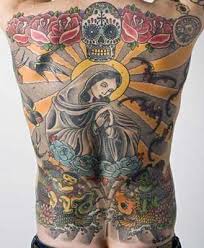 Could you please explain us how all the story began? How did you meet Wim and which one of you got the idea of this incredible tattoo?
"In 2006, my girlfriend Stephanie Schleiffer was working for the de Pury & Luxembourg gallery in Zurich. She was responsible for the upcoming spring show titled 'Take a Walk on the Wild Side' which was a group show where Wim was taking part. He wanted to set up his Tattoo Studio with two pigskins. He told Stephanie that for some time he had been looking for a human canvas that he could have tattooed and sold. He hadn't found anyone and he asked her if she knew anyone who wanted to be a 'human tattooed pig' and she gave me a call. I had tattoos already and she asked if I knew anyone who would be interested. She told me the story and I wanted to do it myself immediately. I met Wim in Zurich with my friend and tattoo artist Matt Powers. The design is more or less the same as on the pig Sybille. Matt changed it to fit my back and so it all began."
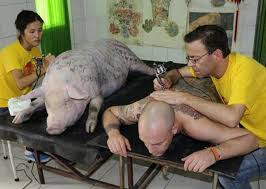 Your back is a work of art, but it's a part of your body. How do you feel about that? Do you have sometimes the impression to be a work of art and to lose your own identity as a human being; as if you were the canvas, Wim and "your owner" the frame?
"I feel like the frame and the canvas. I am the thing that carries the artpiece. Where the art goes, I go. Art is the master and I am the slave. But only as long as I want to be. I'm a free slave. When my back is exhibited I have no identity. When I have a shirt on, the art no longer exists."
Could you tell us what was your impression during your first exhibition as a piece of art and how does it work? Do you still have a right on your body and how many times a year are you "exposed"?
"Being exhibited is a very bizarre experience. I face a wall for many hours (with breaks), listen to loud music and can only sense those around me. Sometimes I interact with people, but I prefer just sitting there. It's a very personal experience which is amazing, peaceful, nerve-wrecking and terrible all in one. I am exhibited as many times as I am asked to and I agree. All the rights are with me. I can quit anytime. But then the money goes back too..."
 I saw many pictures of you posing with pigs, playing with them in the mud or taking a shower in their pens. Is it like a performance for you? As a human being, how do you feel in the middle of animals, treated like them?
"The session with the pigs in China was one of the most remarkable experience in my life. It was a blessing. Being accepted by these majestic animals for a few hours was extraordinary. It felt like a performance on another plateau. I am forever thankful to Wim, Stephanie and all those involved in the China project for that experience."
There is the question about the temporality of the work of art. Your tattoo can change because of the elasticity of your skin and also because the skin is made of living cells. What do you expect for the future? How do you imagine yourself in 40 years?
"It will decay over time. The more time passes, the more ugly it will look. I hope that I will be a canvas on show for all my life. 'TIM' will be really interesting in 40 or 50 years. A decomposing art piece with decades of stories. The only difference being that this canvas can share these stories with everyone."
Dear Tim, thank you so much for having done this interview. It was a pleasure to write about your story which is amazing! I am thinking about having more tattoos but I couldn't hold a candle to you!
For those who may want to know more about Tim, check his website...
All images Courtesy Wim Delvoye - Tim Steiner
4.27.2010
Philippe Perrin, artist
Good evening contemporary art lovers!
I am very glad to introduce to you Philippe Perrin who is a fantastic French artist, most known for his sculptures of monumental scale weapons, handcuffs, knifes, razorblades, American punches... Expanding everyday objects gives them a new meaning, another interpretation and it's even stronger when it comes to weapons. His references are provided by the gangsta aesthetic but also by the classic literature and romantic poetry. He perfectly knows how to be provocative, cynical, and manipulative while remaining charming and seductive.
 Dear Philippe, the MEP (European House of Photography) is going to host a retrospective of your works. Could you please tell us about this exhibition and explain to us how you have wanted organize it?
First, it's not a retrospective but rather a synthesis - an inventory on photography in my work since 1986. A retrospective would freeze in time a life still full of excitement. Moreover, it would have taken all the surrounding neighborhood if we had wanted to install my sculptures retrospectively.
Remember that it's the European House of Photography, which as its name suggests is focused on that medium. This exhibition is a path between objects, sculptures, drawings, soundtracks and video; a selection that is built around a selection of photographs from 1986 to today.
 This exhibiton is entitled "Haut et Court" ("High and Short")? Is it a direct reference to the installation that you made in 1997?
Yes but it's also a reference to the Western films dear to our childhood, a tribute to Louis Mandrin (a French highway robber pre-revolutionary), to thugs and other infamous criminals that make up my personal pantheon, from Caravaggio to Francois Villon, Arthur Cravan or Jacques Mesrine. And then in the French art scene, in which one attempts to hang out people who, like me, stand out from the group, metaphor was obvious.
 Expending weapons gives them weight; they are bigger than humans. Weapons refer to war, violence, cruelty... but ultimately they are the reflection of our society, aren't they?
It's both a seductive object and an infant image, and in the same time what we see everyday on the TV or in the streets. The artist is just the mirror that reflects his own vision of life and society in which he lives. That's, in any case, my only possible definition of art. Art reflects filtered or selected images to give people something to think or offer them another vision. I am just a distorting mirror that magnifies reality to unveil it to the others.
You are a polymorphic artist whose work is particularly characteristic. Is there any movement to which one you feel connected by the approach, the subject, the creative process?
I don't belong to any group and I don't have any label. I am not in any too-easily-identifiable category. I have friends who are artists and very different from each others such as Wim Delvoye and Jacques Villegle, people for whom I have some respect like Robert Longo. The list is important: musicians from everywhere, movies directors, gangsters, etc. But I don't belong to any group. It's not even a choice. It's like that.
Your first pieces of art are deployed around Arthur Cravan, poet and boxer (so do you), nephew of Oscar Wilde. He was a dandy and that's what one says about you. How could you define a post-modern dandy and do you consider yourself as one of them?
Definition of a dandy is a man who takes care of his manners, his presentation and who has wit. I take care of my bad manners, my presentation is just what I give to be seen by others and my wit is twisted. A kind of dandyism, probably, but I feel so far from all those who wander in boulevard Saint Germain in Paris and for whom appearance is the only goal and who give so much trouble to take care of their manners without having any wit. The word "dandy" has been stolen, it has become almost pejorative.
A dandy? A highwayman? A highway"dandy"?
 Only when one is on the precipice can we ask the basics questions: Who am I? Where am I? What should I do? Am I being sincere and honest? Yes. Definitely yes. At least I try to be like that. Especially, I try to be a man... to become a man. We must lead ourselves, force ourselves not to feel dizzy, stay between the attraction/abstraction of the vacuum and the relation to the matter, become a North America Indian and climb barefoot on the steel girders of the New York sky-scrapers. I voluntarily walk on the razor's edge, like a drunken tightrope walker, facing the abyss, especially without a net, above all, without cheating. This is my way of being and my only way of thinking, transmitting. I do it for myself, I do it for the others... Each exhibition is like a little death, each work of art is a new birth...
Dear Philippe, thank you so much!! I am so sad I missed the opening! I wish you all the best and for those who are in Paris: you must visit his show...
I am very glad to introduce to you Philippe Perrin who is a fantastic French artist, most known for his sculptures of monumental scale weapons, handcuffs, knifes, razorblades, American punches... Expanding everyday objects gives them a new meaning, another interpretation and it's even stronger when it comes to weapons. His references are provided by the gangsta aesthetic but also by the classic literature and romantic poetry. He perfectly knows how to be provocative, cynical, and manipulative while remaining charming and seductive.
 Dear Philippe, the MEP (European House of Photography) is going to host a retrospective of your works. Could you please tell us about this exhibition and explain to us how you have wanted organize it?
First, it's not a retrospective but rather a synthesis - an inventory on photography in my work since 1986. A retrospective would freeze in time a life still full of excitement. Moreover, it would have taken all the surrounding neighborhood if we had wanted to install my sculptures retrospectively.
Remember that it's the European House of Photography, which as its name suggests is focused on that medium. This exhibition is a path between objects, sculptures, drawings, soundtracks and video; a selection that is built around a selection of photographs from 1986 to today.
Yes but it's also a reference to the Western films dear to our childhood, a tribute to Louis Mandrin (a French highway robber pre-revolutionary), to thugs and other infamous criminals that make up my personal pantheon, from Caravaggio to Francois Villon, Arthur Cravan or Jacques Mesrine. And then in the French art scene, in which one attempts to hang out people who, like me, stand out from the group, metaphor was obvious.
 Expending weapons gives them weight; they are bigger than humans. Weapons refer to war, violence, cruelty... but ultimately they are the reflection of our society, aren't they?
 It's both a seductive object and an infant image, and in the same time what we see everyday on the TV or in the streets. The artist is just the mirror that reflects his own vision of life and society in which he lives. That's, in any case, my only possible definition of art. Art reflects filtered or selected images to give people something to think or offer them another vision. I am just a distorting mirror that magnifies reality to unveil it to the others.
You are a polymorphic artist whose work is particularly characteristic. Is there any movement to which one you feel connected by the approach, the subject, the creative process?
I don't belong to any group and I don't have any label. I am not in any too-easily-identifiable category. I have friends who are artists and very different from each others such as Wim Delvoye and Jacques Villegle, people for whom I have some respect like Robert Longo. The list is important: musicians from everywhere, movies directors, gangsters, etc. But I don't belong to any group. It's not even a choice. It's like that.
Your first pieces of art are deployed around Arthur Cravan, poet and boxer (so do you), nephew of Oscar Wilde. He was a dandy and that's what one says about you. How could you define a post-modern dandy and do you consider yourself as one of them?
Definition of a dandy is a man who takes care of his manners, his presentation and who has wit. I take care of my bad manners, my presentation is just what I give to be seen by others and my wit is twisted. A kind of dandyism, probably, but I feel so far from all those who wander in boulevard Saint Germain in Paris and for whom appearance is the only goal and who give so much trouble to take care of their manners without having any wit. The word "dandy" has been stolen, it has become almost pejorative.
A dandy? A highwayman? A highway"dandy"?
 Only when one is on the precipice can we ask the basics questions: Who am I? Where am I? What should I do? Am I being sincere and honest? Yes. Definitely yes. At least I try to be like that. Especially, I try to be a man... to become a man. We must lead ourselves, force ourselves not to feel dizzy, stay between the attraction/abstraction of the vacuum and the relation to the matter, become a North America Indian and climb barefoot on the steel girders of the New York sky-scrapers. I voluntarily walk on the razor's edge, like a drunken tightrope walker, facing the abyss, especially without a net, above all, without cheating. This is my way of being and my only way of thinking, transmitting. I do it for myself, I do it for the others... Each exhibition is like a little death, each work of art is a new birth...
Dear Philippe, thank you so much!! I am so sad I missed the opening! I wish you all the best and for those who are in Paris: you must visit his show...
3.30.2010
Robert Goff, art dealer
Good evening contemporary art lovers!
I am very glad and proud to introduce to you Robert Goff who is a contemporary art dealer and whose the gallery is located on the 23rd street in Chelsea. He is one of the first person that I really have met in New York working in the art market and he is the one who has given me a chance to work with...
 Dear Robert, could you please introduce yourself and explain us how you got into the art market. Was your family working on or not? What studies did you do?...
"My name is Robert Goff and I own a gallery in Chelsea of the same name. I grew up in Minneapolis in the early 1970s going frequently to museums like the Walker Art Center and the Minneapolis Institute of Art. My father was interested in art and my parents collected a bit. And I liked to draw and attempt to make art myself so I was always interested in anything visual. I tried to buy my first work of art when I was ten years old but my parents thankfully said no. I ended up studying literature and when I got my first job in New York it was as a journalist for Forbes Magazine. When the position opened to write about art collecting and the auction market I jumped at it. After that I worked for some internet companies related to the art world and eventually started my own gallery with a partner about seven years ago. At the end of the day I really am interested in the art object and the conversation that can happen around it."
For those who may don't know, could you explain what are the differences between the first and the second market and what is the place taken by the gallery?
"The "primary" market is what a gallery like mine does. I represent 12 artists and sell their work to collectors and museums. This initial sale of a piece from a gallery to it's first buyer is the "primary"sale. A secondary sale occurs when the piece is resold - even if a work is resold 20 times it's called a secondary sale. The "secondary" market refers to all works that are resold over time - obviously this includes Picassos and Warhols but also some very young artists as well. Secondary market sales are conducted by galleries, individual dealers and collectors and auction houses."
Are you specialized in any particular movement and who are the artists whom you exposed?
"In my dealings as a primary gallery I am focused on international significant emerging artists who have a very strong grounding in technique and skill - whether that's painting, drawing, photography or filmmaking. I am less interested in artists that make work that looks shoody, whether they claim that's deliberate or not. Kevin Francis Gray reimagines classical sculpture through a contemporary lens, Melanie Manchot makes subtle photo and video portraits of individuals as they relate to larger groups and society, Simon English makes exquisitely perverse drawings that dance out of his subconscious, Ahmed Alsoudani's visceral paintings slam the viewer with images of a world in wartime agony, Isca Greenfield-Sanders makes quiet but deeply felt paintings about the American experience, Oliver Pietsch makes brilliant montages from the history of film that draw out universal themes of love, betrayal, dreams and nightmares and despair, Scott Hunt's perfectly rendered charcoal drawings are dark, humorous explorations of the myths and traditions of American society, Iona Rozeal-Brown has created a new cosmology of characters in her paintings that reimagines hip hop, Japanese and African-American culture, Titus Kaphar's paintings really undoes both physical and historical traditions of painting, Suzanne Kuhn makes and solves complicated problems presented by painting on canvas, Type A is a collective of two New York males who explore the truths and excesses of masculinity and competition through sculpture, installation, performance and photography and Ain Cocke makes some of the most technically gorgeous portraits anywhere today."
What did you think about the art fairs and what is your opinion about the evolution of the market?
"Art fairs are important but to be indulged in with moderation. At their best fairs will introduce you to new collectors and curators and enable sales and at the worst they're an expensive waste of time. I am personally really excited by really high quality fairs that are in new and emerging regions of the world. We had a great time doing Art Dubai last year and I'm excited to participate in Art Hong Kong in May. THese are both places in the world where collecting contemporary art is relatively new and people are excited about it - conditions which make it both fun and good for business."
What kind of advice would you give to a young art dealer?
"First, be totally honest in all your dealings. Second, when you make a sale pay your artists before you pay yourself. Third, look before you leap-test out the waters with artists before you sign them, really evaluate a fair before you sign up for it and don't follow the herd."
Thank you, Robert, having answering to those questions!! Good luck for the Hong Kong fair...
To those who frequently wander in Chelsea, stop by Robert's gallery!
I am very glad and proud to introduce to you Robert Goff who is a contemporary art dealer and whose the gallery is located on the 23rd street in Chelsea. He is one of the first person that I really have met in New York working in the art market and he is the one who has given me a chance to work with...
 Dear Robert, could you please introduce yourself and explain us how you got into the art market. Was your family working on or not? What studies did you do?...
"My name is Robert Goff and I own a gallery in Chelsea of the same name. I grew up in Minneapolis in the early 1970s going frequently to museums like the Walker Art Center and the Minneapolis Institute of Art. My father was interested in art and my parents collected a bit. And I liked to draw and attempt to make art myself so I was always interested in anything visual. I tried to buy my first work of art when I was ten years old but my parents thankfully said no. I ended up studying literature and when I got my first job in New York it was as a journalist for Forbes Magazine. When the position opened to write about art collecting and the auction market I jumped at it. After that I worked for some internet companies related to the art world and eventually started my own gallery with a partner about seven years ago. At the end of the day I really am interested in the art object and the conversation that can happen around it."
For those who may don't know, could you explain what are the differences between the first and the second market and what is the place taken by the gallery?
"The "primary" market is what a gallery like mine does. I represent 12 artists and sell their work to collectors and museums. This initial sale of a piece from a gallery to it's first buyer is the "primary"sale. A secondary sale occurs when the piece is resold - even if a work is resold 20 times it's called a secondary sale. The "secondary" market refers to all works that are resold over time - obviously this includes Picassos and Warhols but also some very young artists as well. Secondary market sales are conducted by galleries, individual dealers and collectors and auction houses."
Are you specialized in any particular movement and who are the artists whom you exposed?
"In my dealings as a primary gallery I am focused on international significant emerging artists who have a very strong grounding in technique and skill - whether that's painting, drawing, photography or filmmaking. I am less interested in artists that make work that looks shoody, whether they claim that's deliberate or not. Kevin Francis Gray reimagines classical sculpture through a contemporary lens, Melanie Manchot makes subtle photo and video portraits of individuals as they relate to larger groups and society, Simon English makes exquisitely perverse drawings that dance out of his subconscious, Ahmed Alsoudani's visceral paintings slam the viewer with images of a world in wartime agony, Isca Greenfield-Sanders makes quiet but deeply felt paintings about the American experience, Oliver Pietsch makes brilliant montages from the history of film that draw out universal themes of love, betrayal, dreams and nightmares and despair, Scott Hunt's perfectly rendered charcoal drawings are dark, humorous explorations of the myths and traditions of American society, Iona Rozeal-Brown has created a new cosmology of characters in her paintings that reimagines hip hop, Japanese and African-American culture, Titus Kaphar's paintings really undoes both physical and historical traditions of painting, Suzanne Kuhn makes and solves complicated problems presented by painting on canvas, Type A is a collective of two New York males who explore the truths and excesses of masculinity and competition through sculpture, installation, performance and photography and Ain Cocke makes some of the most technically gorgeous portraits anywhere today."
What did you think about the art fairs and what is your opinion about the evolution of the market?
"Art fairs are important but to be indulged in with moderation. At their best fairs will introduce you to new collectors and curators and enable sales and at the worst they're an expensive waste of time. I am personally really excited by really high quality fairs that are in new and emerging regions of the world. We had a great time doing Art Dubai last year and I'm excited to participate in Art Hong Kong in May. THese are both places in the world where collecting contemporary art is relatively new and people are excited about it - conditions which make it both fun and good for business."
What kind of advice would you give to a young art dealer?
"First, be totally honest in all your dealings. Second, when you make a sale pay your artists before you pay yourself. Third, look before you leap-test out the waters with artists before you sign them, really evaluate a fair before you sign up for it and don't follow the herd."
Thank you, Robert, having answering to those questions!! Good luck for the Hong Kong fair...
To those who frequently wander in Chelsea, stop by Robert's gallery!
1.07.2010
Fabien Verschaere, artist
Good afternoon contemporary art lovers!
I am really pleased to introduce to you one of my best friends: a French emerging artist. The first time I discovered his work I fell in love. His works of art are figurative. He shows us a world based on a fantasy land where all the characters are created from legends, fairy tales, as well as his imagination. Monsters, clowns, fairies, ghosts coexist all together amid castles, 'smileys', and some objects from our daily life. On each of his works he represents himself somewhere; whether he portrays himself in a dark or saint-like manner. The canvas can be disconcerting at a glance. The contrast between life and death, health and disease are depicted in his works. At first sight his work can seem to be very funny and cheerful, but his work is very intense, hard and interesting. You can't take your eyes of it and every interpretations are allowed.
He is a painter but also a sculptor and a designer. He uses Posca and paints most of the time black figures on white background.
 Hey Fabien, how are you today? Happy working on your next solo show at Enrico Navarra gallery in February in Paris? Tell us about this new exhibition...
In fact, as usual, it consists to show the last pieces that I produced for the last past months. I looked a lot the Mexican art and everything related to the Baroque art, classic or contemporary. I think American art becomes more and more baroque; American tradition such as halloween or the imagery which can be found in the streets of New York all inspired me. I think my residency in NY that I had last year has been very helpful because I rediscovered all the things I love and I still want to explore through painting, as comics and popular arts. The exhibition's title is "sweet inspiration" because it reflects my own life and because it combines the excitement that I have thanks to my practices which mix my feelings with a practice codified and decoded. People have the key of what I want to express!
 When I was with you at the atelier for the first time, I realized you paint without preparatory sketches and you usually begin in the middle of the canvas. Could you please explain us your process?
There is no any particular process in my work, it is a question of feeling and that is why I am still painting. Sketches are for the security of the artist and I take art as an active performance, a new look on the world each time I paint. At the beginning I directly painted on the wall in the museums which gave me confidence to create big compositions made without any sketches, just me against the wall. Wall became a friend, a mirror on which I tell my mental records which come from my travels and from my personal experiences.
When you were a student, who inspired you and has your style changed?
At the beginning I was inspired by Combas, Basquiat, Haring then I looked a lot Boltanski, Beuys and the american Minimalists. Then I worked on the Viennese actionists. Reflexion on the idea of the subject bring me to my actual work. One day I decided that there had only two different ways to paint: represent the same subject all my life or try to paint everything the life makes me discover. I chose the second one.
 What do you want to tell to the one who would like to make a comparison between you and the artists from the street (art), the graffitists... or even the comics?
I don't think I have a direct relation with street art. The only thing is I work with one acrylic felt pen stroke, directly on the canvas, and I give informations with a poetic way as graffitists do. The only thing I can understand which is issued from the contemporary art is the mix between mass medias, music, television, theater, movies, cartoons and everything which belongs to our world. That is why I want use everything from the street art to the Italian Quatrocento.
You are a painter but also a sculptor, a drawer and a designer. What is your favorite medium, the one with which you are more comfortable and why?
I am interested by all of these mediums, I touch, I try, I create... I have no preference I am like a child who discover every day what "to create" meaning...
Thank you so much Fabien! Good luck for the exhibition...
Guys if you like his work go for it but be patient I belong to those who bought the last paintings!
I am really pleased to introduce to you one of my best friends: a French emerging artist. The first time I discovered his work I fell in love. His works of art are figurative. He shows us a world based on a fantasy land where all the characters are created from legends, fairy tales, as well as his imagination. Monsters, clowns, fairies, ghosts coexist all together amid castles, 'smileys', and some objects from our daily life. On each of his works he represents himself somewhere; whether he portrays himself in a dark or saint-like manner. The canvas can be disconcerting at a glance. The contrast between life and death, health and disease are depicted in his works. At first sight his work can seem to be very funny and cheerful, but his work is very intense, hard and interesting. You can't take your eyes of it and every interpretations are allowed.
He is a painter but also a sculptor and a designer. He uses Posca and paints most of the time black figures on white background.
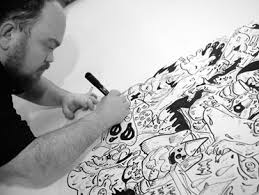 Hey Fabien, how are you today? Happy working on your next solo show at Enrico Navarra gallery in February in Paris? Tell us about this new exhibition...
In fact, as usual, it consists to show the last pieces that I produced for the last past months. I looked a lot the Mexican art and everything related to the Baroque art, classic or contemporary. I think American art becomes more and more baroque; American tradition such as halloween or the imagery which can be found in the streets of New York all inspired me. I think my residency in NY that I had last year has been very helpful because I rediscovered all the things I love and I still want to explore through painting, as comics and popular arts. The exhibition's title is "sweet inspiration" because it reflects my own life and because it combines the excitement that I have thanks to my practices which mix my feelings with a practice codified and decoded. People have the key of what I want to express!
 When I was with you at the atelier for the first time, I realized you paint without preparatory sketches and you usually begin in the middle of the canvas. Could you please explain us your process?
There is no any particular process in my work, it is a question of feeling and that is why I am still painting. Sketches are for the security of the artist and I take art as an active performance, a new look on the world each time I paint. At the beginning I directly painted on the wall in the museums which gave me confidence to create big compositions made without any sketches, just me against the wall. Wall became a friend, a mirror on which I tell my mental records which come from my travels and from my personal experiences.
When you were a student, who inspired you and has your style changed?
At the beginning I was inspired by Combas, Basquiat, Haring then I looked a lot Boltanski, Beuys and the american Minimalists. Then I worked on the Viennese actionists. Reflexion on the idea of the subject bring me to my actual work. One day I decided that there had only two different ways to paint: represent the same subject all my life or try to paint everything the life makes me discover. I chose the second one.
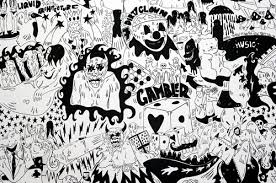 What do you want to tell to the one who would like to make a comparison between you and the artists from the street (art), the graffitists... or even the comics?
I don't think I have a direct relation with street art. The only thing is I work with one acrylic felt pen stroke, directly on the canvas, and I give informations with a poetic way as graffitists do. The only thing I can understand which is issued from the contemporary art is the mix between mass medias, music, television, theater, movies, cartoons and everything which belongs to our world. That is why I want use everything from the street art to the Italian Quatrocento.
You are a painter but also a sculptor, a drawer and a designer. What is your favorite medium, the one with which you are more comfortable and why?
I am interested by all of these mediums, I touch, I try, I create... I have no preference I am like a child who discover every day what "to create" meaning...
Thank you so much Fabien! Good luck for the exhibition...
Guys if you like his work go for it but be patient I belong to those who bought the last paintings!
Subscribe to:
Posts (Atom)
